
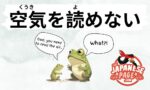


Imagine this. A friend comes to you with tears welling in her eyes. “My boyfriend just dumped me,” she tells you. Just as you are about to give her words of comfort, another friend jumps into the conversation and says, “You ever heard the one about a bear who walks into a bar?”
Now, how do you express what you want to tell him in Japanese?

空気を読めない
The Japanese expression "空気を読めない" literally means "can't read the air." It is used to describe someone who is socially awkward or unaware, lacking the ability to pick up on social cues, context, or the mood of a situation.
Some translations might include:
- Can't read the atmosphere.
- Can't read the room.
- Can’t read between the lines.
- Can't pick up on the vibes
- Can't read the situation.
- Don't have a clue.
- Can't sense someone's feelings.
Japanese Culture
While all these are useful in English, 空気を読めない is far more useful in Japanese since “getting a read” on a situation nonverbally is far more important in Japanese culture.
In Japanese culture indirect communication is often valued over direct statements. Therefore, understanding what is left unsaid is as important as understanding what is actually said.
One other difference is most of the English translations above don't include the nuance of caring about how one is perceived by others. The Japanese 空気を読めない is all about that.
This is another example where culture and language cannot be separated.

Japanese people are generally more concerned about how others perceive them than people in most Western cultures are. Furthermore, because Japanese communication tends to be less direct, what would be spoken openly in Western cultures is often left unsaid. Therefore, the ability to "read the air" is essential.
Vocabulary Breakdown:
- 空気 air; atmosphere
- を [direct object marker]
- 読めない can't read [Negative potential form of 読む (to read)]
Examples:
Let’s look at a few example situations.
- At a Meeting: If everyone in a business meeting seems to agree on a certain point, and one person loudly disagrees without recognizing the general consensus, that person might be described as "空気を読めない."
- Social Gathering: If someone continues to talk loudly on their phone in a quiet café where everyone else is engaged in quiet conversation or focused on their work, they might be labeled as "空気を読めない."
- Family Gathering: If a family is quietly mourning the recent loss of a loved one, and someone starts talking about something cheerful or unrelated, they might be seen as "空気を読めない."
- Romantic Setting: If a couple is enjoying a (potentially) romantic moment and another person joins them as a third wheel, that person might be described as "空気を読めない."
Shortening 空気を読めない
This is a shortened negative form of 場の空気を読む, reading the air of the situation.
Even though 「空気を読めない」 is a shortened version of 場の空気を読む, it is still too long! As you know, Japanese love to abbreviate. 「空気を読めない」 becomes "KY."
That's right. You might see "KY" written online and now you know it means 空気を読めない.
When spoken, it is pronounced 「ケイワイ」.
But why "KY"? It's for the two alphabet letters in the phrase: Kuuki o Yomenai
This is very slangy but also used quite a lot now.
Here are two quick examples:
彼、KYだね。
He's a bit socially awkward (or unaware).
めちゃKYだね。
Totally clueless, isn't (he)?
Vocabulary
Warning Someone with KY
So, what do you do when someone is very sad because her boyfriend just dumped her and another friend jumps into the conversation telling a salty joke? You can say:
空気読めよ!
or
KYだな!!
In English, we might say something like:
- Read the room!
- Get a clue!
- Sense the atmosphere!
- Pay attention to the mood!
- Can't you read the situation?
But in Japanese, you tell them to "Read the air."
Final Thoughts
A similar expression is 「暗黙の了解」 which means “unspoken understanding” or “tacit agreement.”
The word "暗黙" means "silence" or "tacit," and "了解" means "understanding" or "consent." Combined, they reflect an agreement or understanding that hasn't been verbalized but is mutually understood.
It is important to remember that Japanese culture often values understanding and respecting the unspoken rules or expectations within a social setting more so than explicit verbal communication. "Reading the room" isn't just a cool set phrase, but also gives us a glimpse into how Japanese communicate.


I love these so much!!! And I’m always sharing them on the Discord groups I’m in.
Thanks! Please share away 🙂 I’ll do more soon.