
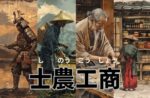


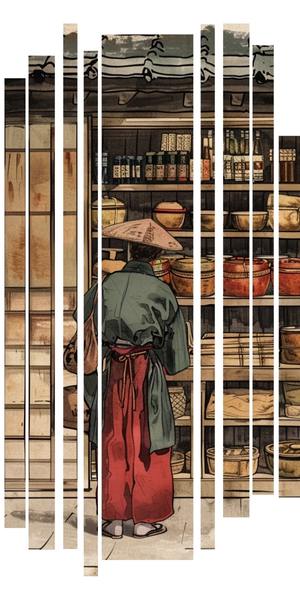
Japan's class system, shaped by ancient Chinese concepts, used the 士農工商 model to classify people's jobs into four main groups:
- 士: This originally referred to scholars or gentlemen in China, but in Japan, it represented the samurai, the warrior class.
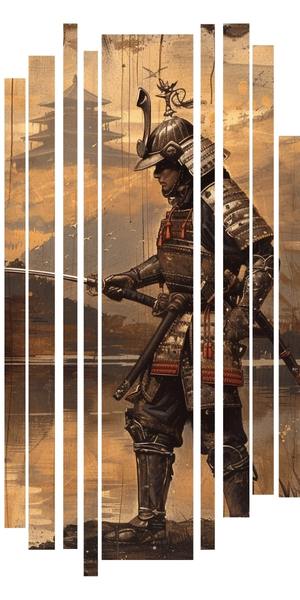
- 農: The farmers, who played a vital role in food production.
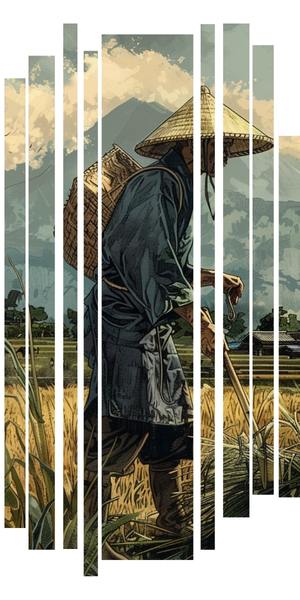
- 工: Artisans and craftsmen, the creators of goods.
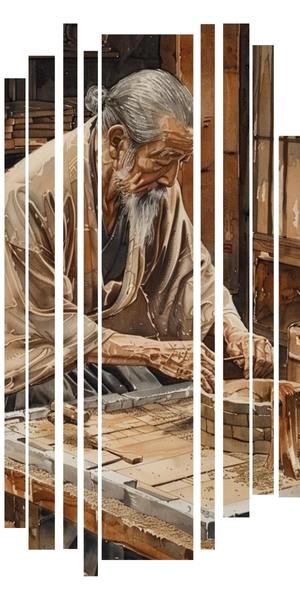
- 商: Merchants and traders.
士農工商
In China, these groups weren't rigidly fixed. They weren't exactly social classes, and they weren't inherited from your family; it was simply a way to generalize all types of people in society. However, when Japan adopted this system, the idea was that you were born into your class, and crossing lines, like marrying someone from a different class, was frowned upon.
Post-Meiji historians used to think this system in Edo period Japan was very strict. But modern research suggests it wasn't as rigid as previously thought. Even though there was a supposed hierarchy, there was some wiggle room, especially for lower-ranking samurai and richer farmers. The lines between classes weren't as sharp, and people could move up or down more than expected.
Because of these new insights, the traditional view of 士農工商 is considered outdated, and it's not emphasized in current Japanese textbooks. It turns out that Japan's historical social structure was more dynamic and interconnected than simply four separate boxes.
Still, it makes for a fascinating language lesson. And so, let's go through the kanji...

Makoto+ Members, click here to download a PDF, all the sound files ,and an Anki flashcard deck just for this lesson. Practice makes perfect!
Break it Down
Let's look at the kanji and learn important words from them.
士
- Kun: さむらい
- On: シ
- Meaning: gentleman; scholar
Mnemonic Story:
A true gentleman 士 stands tall and proud, representing the ideal of wisdom and respect.
Notes: Be careful to not confuse it with 土 (dirt; earth). The samurai gentleman 士 has longer arms and the line for earth 土 has a longer line for the ground.
Examples:
弁護士
lawyer; attorney
武士
samurai; warrior
博士
expert; doctor; PhD [Also pronounced 「はかせ」]
紳士
gentleman
士気
morale (of troops or team)
農
- On: ノウ
- Meaning: agriculture; farmers
Kanji Components:
- 曲 song; bend
- 辰 morning; dragon
Mnemonic Story:
The agriculture 農 thrives as the farmers bend 曲 in their fields, singing songs 曲 of old, while the morning 辰 dragon 辰 watches over them, blessing their efforts with fruitful harvests.
Examples:
農家
farmer; farm family
農業
agriculture; farming
農場
farm; plantation
酪農
dairy farming
農薬
agricultural chemical; pesticide
工
On: コウ、 ク、 グ
Meaning: 工 work; labor; skill
Mnemonic Story: Work 工 requires skill and precision, as if measuring everything with a right angle for perfect craftsmanship.
Examples:
工場
factory; plant
工学
engineering
工事
construction work
大工
carpenter
工夫
scheme; device
細工
workmanship; craftsmanship; handiwork
商
- Kun: あきな.う
- On: ショウ
- Meaning: make a deal; selling; dealing in; merchant
Kanji Components:
- 亠 lid; cover
- 儿 legs
- 冂 wide
- 口 mouth
Mnemonic Story: In the world of commerce 商, a clever merchant covers 亠 his goods, creating intrigue. His strategy involves walking 儿 far and wide 冂, sharing stories 口 that captivate his audience and seal his deals.
Examples:
商品
product; commodity; goods; merchandise
商人
merchant; trader
商売
trade; business; commerce
商標
trademark; brand
商店
shop; small store

Match the Meaning
Flip two cards to match the Japanese with the English.

Makoto+ Members, click here to download a PDF, all the sound files ,and an Anki flashcard deck just for this lesson. Practice makes perfect!



After the 5th question on the quiz, the screen doesn’t reset. Arigatou.