


Japanese Pronouns
IMPORTANT: Japanese is famous for dropping pronouns.
Once the topic or subject of a conversation is established, it is awkward to continually use the pronoun. And yet, ironically, there are tons of pronouns available for use—even more when considering dialects.
English has only a few pronouns and it would be awkward to not use them
Japanese has tons of pronouns to choose from, but it is often awkward to use them!
Makoto+ Members, click here to download all the sound files and an Anki flashcard deck just for this lesson. Practice makes perfect!
As mentioned above, you could, and in some cases should, avoid using pronouns altogether.
- When the context is clear, drop the pronoun.
- When speaking to a superior, it is best to use the person’s name with an honorific such as さま or a title such as 先生 (teacher, doctor, or other authorities) or 部長 (section boss). Saying 「あなた」 to your boss, for example, would be considered to berude.
That being said, a few well-placed pronouns can enliven a conversation.
Want to sound like a sixteenth-century samurai warrior? There are pronouns for that. Want to sound more masculine? No problem. Wanna sound like a little girl? Sure.
This is one reason why Japanese is so much fun. You just can't do this easily with English.
General Notes on Pronouns
- When one says “I” in English no information is conveyed other than that it is first person singular. In Japanese, however, most pronouns also carry cultural or social status connotations. See this lesson from the anime Your Name for a funny example of this.
- As long as the meaning is clear, Japanese usually omits the pronoun.
For example:
カールさんは店に行きました。そこで、パンを買いました。
Carl went to the store. There, (he) purchased bread.
Vocabulary
- Once the subject is clear, Carl, “he” is unnecessary in the second sentence even though it is required in English.
- Single words or short sentences usually drop the pronoun as it is assumed the speaker is referring to him or herself.
For example:
腹減った。
(I’m) hungry.
眠い。
(I’m) sleepy.
- Adding the suffix, たち, to the first person pronoun, makes it plural. The kanji is 達.
For example
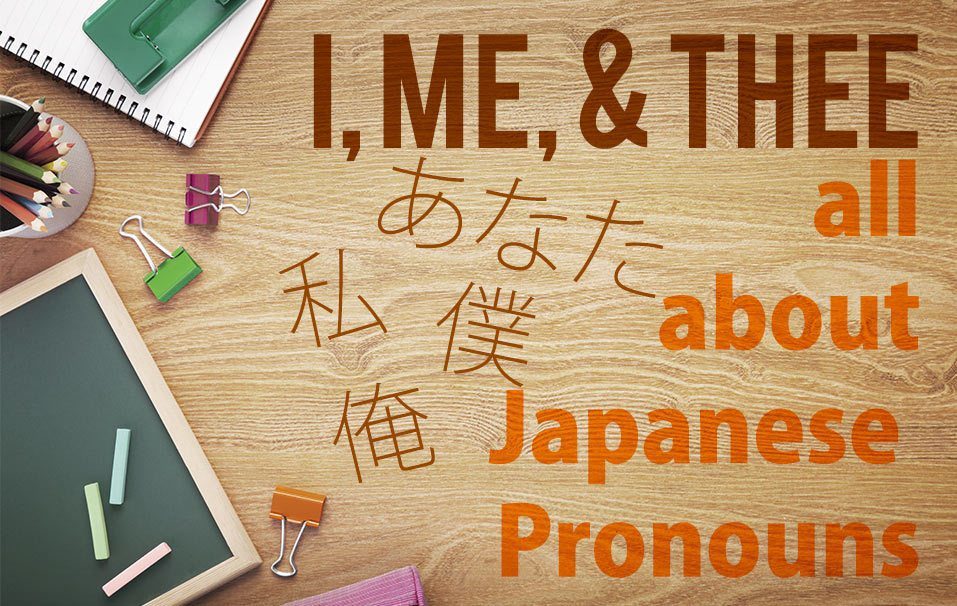
私
I; me
私たち
we; us
あなた
You (used with peers and those under your social standing)
あなたたち
You (all)
君
You (informal)
君たち
You (all)
- ら like たち is a pluralizing suffix. It is most often used with 彼 (he) to make it "they" (third person plural, mixture of males and females)
彼ら
they
- While you can say 彼女たち when the room is full of women or girls, the norm is to use 彼ら for mixed groups or situations when the gender makeup of the group is unknown.
How to NOT Use Pronouns
You can get by your entire life with only using 私 for “I” and あなた for “you,” but not only would that be boring, in some situations it might actually be rude.
あなた, for example, can, in some cases, be rude since it implies you are stating the listener is equal to or inferior to you. And saying 私 too often can make one sound conceited.
Here are a few ways to get around this:
INSTEAD OF 私
- Point to yourself when referring to yourself and simply don't say a pronoun.
INSTEAD OF あなた
- Use the person’s name with さん.
由美さん、どう思いますか?
What do you think, Yumi?
- Use the person’s title: 先生 (for teachers, doctors, pastors, and other authorities and professionals); 社長 (for bosses or company presidents)
先生、トイレに行ってもいいですか?
Teacher, may I go to the bathroom?
- そちら literally means “there” and can be used to refer to your listeners
INSTEAD OF PLURAL PRONOUN
- Refer to everyone as みんな or みなさん
In short, if you can avoid using a pronoun whether through context or substitute, do it.
Now, let’s look at actual pronouns!
+ Everyday Use Pronouns
First Person 一人称
私
I; me
[formal or informal; gender-neutral]
うち
one’s own…
[usually used with の to talk about one’s household: うちの犬 my (our) dog]
Second Person 二人称
あなた
you
[usually said to people on a similar or lower social status; often used by wives to address their husbands like “dear” or “sweetheart”]
君
you
[informal; used among friends; it's the same kanji 君 as the name suffix -kun. Often used with 僕.]
Third Person 三人称
彼女
she; her
[can also be used to mean “girlfriend.”]
彼
he; him
[can also be used to mean “boyfriend.” 彼氏 always means “boyfriend.”]
+ Formal Pronouns
私
【わたくし】 I; me [more formal then just わたし; uses the same kanji as わたし; gender-neutral]
我
I; me [literary style; formal]
我ら
we [literary style]
我が
my (or can be plural: our as in 我が社our company) [gender neutral]
我々
we [formal; used when speaking on behalf of a company or group]
+ Pronouns for Women
あたし
I [a shortened form of わたし used commonly by women]
+ Pronouns for Men
俺
I [gives a sense of masculinity; can be rude in some situations]
僕
I [used by males of all ages, but particularly with boys. Can be used when calling a boy whose name you don’t know: “hey, kid” or “hey, squirt.” The kanji 僕【しもべ】 means “servant”]
わし
I [often used by older males]
+ Archaic Samurai Edo Period “the fun-but-kinda-useless” Pronouns
あっし
I; me [Edo period slang for 私]
拙者
I; me [used by males; samurai pronoun; the kanji means “clumsy person”]
我が輩
I; me [used by males; has a nuance of arrogance; Natsume Soseki’s famous book, I am a Cat, is called 吾輩は猫である.]
某
I; me [used by males; used by samurai as a first person pronoun, but literally means some unknown person]
余
I [used by males] Say this after a good meal: 余は満足じゃ。 I am satisfied.
己
I; oneself [used by males; humble when used as first person pronoun, but hostile when used as a second person pronoun (see below)]
汝
you [used by males and females]
+ Pronouns for When Upset
あんた
you [rude; a shortened version of あなた; used when angry]
お前
you [can be rude or can show familiarity (husband to his wife, for example).]
てめえ
you [rude; used when angry; used by males; also てまえ; kanji: 手前]
貴様
you [rude; historically, this was a formal pronoun the kanji, 貴様 meaning an honorable person]
こいつ
him; her [informal; implies contempt; used to refer to someone nearby]
あいつ
him; her [informal; implies contempt; used to refer to someone away from the speaker and listener.]
己
you [used by males; humble when used as first person pronoun, but hostile when used as a second person pronoun]
+ Less Common Pronouns
おら
I [rural feel; used in anime or manga such as Crayon Shinchan and Dragon Ball characters]
我ら
we [informal; like たち, ら is a pluralizing suffix that usually shows familiarity]
+ Plural Suffixes
~たち
[informal: 私たち we; 君たち you; can also be added to names, groups, or places: 青木さんたち the Aoki’s (residence)]
~ら
[informal: 彼ら they; あいつら they; ]
~とも
[humble; changes to ども; わたくしども]
~かた
[formal; kanji is 方;changes to がた; あなたがた you (plural; more formal than あなたたち]
+ Other
あの人
he; she
[literally, that person; informal to formal]
あの方
he; she
[literally, that person; formal / polite]
あの子
she
[literally, that child, but usually refers to a girl or young woman]
我が社
our company
[used when representing one’s own company]

Makoto+ Members, click here to download all the sound files and an Anki flashcard deck just for this lesson. Practice makes perfect!


All the audio is working for me : ) Just came here after starting the Yuki Onna book
Thanks–I believe we simply had a server error. It seems to be okay now, though.
All the audio clips say error!
It may have been a server hiccup. Please try now. It’s working on my end.