


How to easily remember these confusing katakana characters
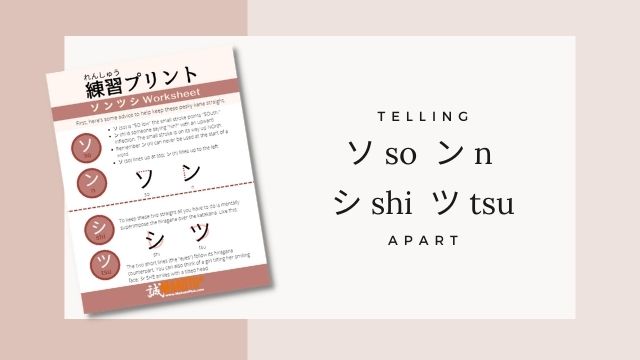
Quick! What is the difference between ソ and ン? Can you tell ツ and シ apart?
If you broke into a slight sweat, don't worry. After this article, you should be able to remember that ソ is "so," ン is "n," シ is "shi," and ツ is "tsu."

While this lesson is free, Makoto+ and Patreon supporters have access to bonus content including a downloadable PDF and sound files. If you are a member, please click here for the bonus content.
Now, back to ソ so ン n and シ shi ツ tsu. We'll start with the easier of the two.
シ shi and ツ tsu
I have three methods to offer you. Hopefully, one or all will stick.
METHOD ONE:
The katakana smiley faces always gave me (Clay) trouble until I realized if you superimpose the corresponding hiragana character, the "eyes" follow the same path.
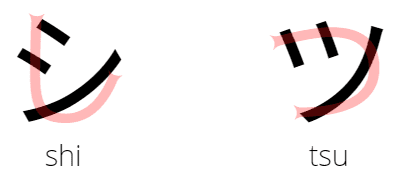
As you can see from the image above, シ (shi) has tilted eyes that follow the hiragana し path.
The katakana ツ (tsu) has eyes side-by-side and follows the hiragana つ path.
METHOD TWO:
You can also think of a girl tilting her smiling face: シ SHE smiles with a tilted head. ツ tsu is just looking at the girl.
METHOD THEE:
S stands for "side" and T stands for "top": シ shi on the side, ツ tsu on the top.
ソ so and ン n
For these two one-eyed smiley faces, I turn to a few mnemonic stories.
- ソ (so) is "SO low" the small stroke points "SOuth."
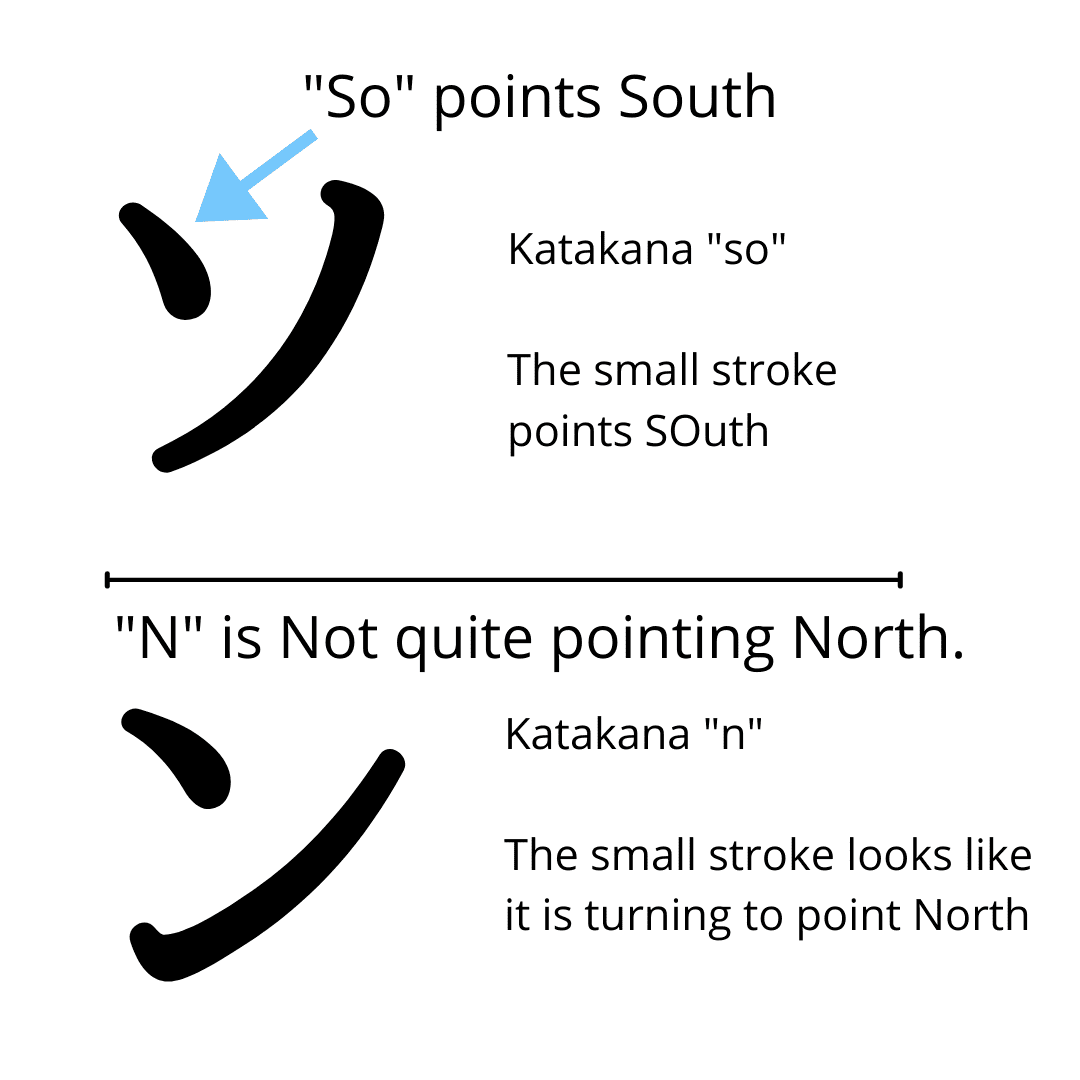
- ン (n) is someone saying "Nn?" with an upward inflection. The small stroke is on its way up NOrth.
- ソ (so) lines up at top; ン (n) lines up to the left:
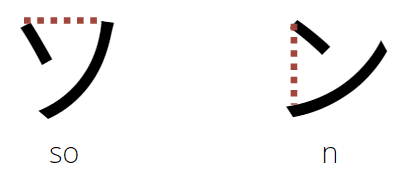
One last tip:
ン (n) can never be used at the start of a word. So, if you see one of these two starting a word, it will be "so"
While not 100% true all the time, if you see one of these two ソ (so) or ン (n) end a word, it will most likely be ン (n)
Now, let's practice. You can skip to 1:30 to start the quiz.


Everyone needs to find their own method to remember how to distinguish these (tricky) characters and the change in stroke order. I will share mine with you, in case it helps anyone:
I had identified five katakana that were giving me trouble: ン(n), シ(shi), ソ(so), ツ(tsu) andノ(no).
First thing I had noticed was the change in stroke order when it comes to the longer stroke. While it is written bottom to top in the case of say シ(shi), it is written from top to bottom for ソ(so).
So I grouped those 5 katakana in two groups, depending on the way the longer stroke was written. That gave me NO, SO and TSU on one side, and N and SHI on the other.
Then to remember which characters go together, I used mnemonics: From NO-SO to sou-TSU (“north to south“), that was group 1. Then I had a friend from Taiwan at school whose name was Yenshi. That became: N-shi.
Now for the shape and direction of the characters. The “north to south“ group is written from left to right and, obviously, from top to bottom. You know “north to south“. It also looks a bit more squeezed and vertical than the „n-shi“ group. The latter is written more horizontally as it travels sideways, not north to south ?
Well, that cleared up the confusion for me. Hope it does for some of you, too. And yes: I am a bit nuts.
Your grouping methods became 10x more confusing to remember! I really like Method 1 for shi-tsu. And I’m getting a hang of so-no as it relates to south and north. Thank you!