
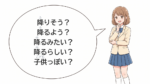


Five Japanese endings all come out as it seems in English: そう, よう, みたい, らしい and っぽい. Japanese asks a question English does not: how do you know? Did you see it with your own eyes, work it out in your head, or hear it from somebody else? Each answer gets its own ending, and picking the wrong one does not make you ungrammatical. It makes you sound like you are claiming something you have no business claiming.
Every example sentence has audio, and its English is blurred on purpose. Read the Japanese first, then tap the blur to check yourself.
Here are the five, four of them dressed on the same verb:
降りそう ・ 降るよう ・ 降るみたい ・ 降るらしい子供っぽいthe first four all mean some version of “it looks like rain”; the fifth is a different animal
Why These Five Get Confused
Because an English-speaking brain files them all under one word. It seems, it looks like, apparently, I hear, -ish — in English those are stylistic choices, and you can swap them around freely.
In Japanese they are not stylistic. Each one makes a claim about where your information came from, and a listener hears that claim whether you meant it or not.
Before you choose, point at where you got it. Your eyes means そう. Your head means ようだ if you are being formal and みたい if you are not. Their mouth means らしい, or ~そうだ when you are quoting. A shrug means っぽい.
The Five at a Glance
| Form | The one-line version | Where the information came from | How it sounds |
|---|---|---|---|
| ~そう | It looks that way, right now. | Your own eyes | Neutral |
| ~そうだ | I hear that… | Somebody told you; you quote it | Neutral |
| ~ようだ | It appears to be the case. | Your own reasoning, from evidence | Formal |
| ~みたい | Looks like… | The same reasoning, spoken | Casual |
| ~らしい | Apparently… | Somebody else; you keep your distance | Neutral |
| ~っぽい | Sort of… -ish. | A vague impression | Slangy |

The whole lesson on one card.
そうWhat Your Eyes Can See
How to build it: verb ます-stem + そう, or an い-adjective with its い dropped, or a な-adjective as it stands. A noun cannot take it at all. Two exceptions worth memorizing: いい → よさそう, ない → なさそう.
空が暗いです。雨が降りそうです。
[The first half supplies the evidence and the second half reads it. That is そう doing its job in two short sentences.]
One い Changes Everything
This is the trap, and it catches everybody exactly once. There is a second そう, and it means the opposite of the first.
The そう above attaches to a stem and reports what you can see. The other one attaches to the plain form and reports what you were told. On an い-adjective they land one letter apart:
美味しそう (it looks delicious — I am looking at it)美味しいそう (I hear it is delicious — somebody told me)
天気予報によると、明日は雨が降るそうです。
[~によると names the source out loud, and the hearsay そうだ is the ending that source wants. You are relaying, not judging.]
The quick way to tell them apart: look at what sits immediately before そう. A stem means your eyes. A complete plain form means somebody’s mouth.
ようWhat You Have Worked Out
How to build it: plain form + ようだ. A noun takes の in front and a な-adjective takes な. This is the formal end of the whole group — what you write, and what you say at work.
電気が消えています。誰もいないようです。
[You cannot see an absence. You see darkness and conclude an absence, and that step from evidence to conclusion is what ようだ marks.]
ようだ has a second job that has nothing to do with seeming: ~のように and ~のような make comparisons, and this is the ordinary way to say “like” in Japanese — 氷のように冷たい, as cold as ice.
みたいThe Same Thought, Out Loud
How to build it: the easiest of the five. Everything attaches bare — no の, no な, no だ. Then みたい behaves like a な-adjective: みたいな before a noun, みたいに before a verb.
電気が消えてる。誰もいないみたい。
[The same thought as the ようです sentence above, said to a friend instead of written in a report. Note 消えてる rather than 消えています — casual all the way through.]
らしいWhat Somebody Else Said
How to build it: plain form + らしい, and a bare noun attaches directly. You heard it, you are passing it on, and there is a small deliberate distance between you and the claim.
部長は来週、大阪に行くらしいですよ。
[Classic office らしい. Somebody mentioned it, you are repeating it, and that distance is what keeps you out of trouble if it turns out to be wrong.]
らしい has a second job too, and it is not “seems” at all. On a noun it can mean behaving as that thing ought to behave: 春らしい天気 says it is spring and the weather is living up to it. Say 春のような天気 instead and you have implied it is not spring at all.
っぽいA Shrug, in Grammar
How to build it: attach it to a noun (子供っぽい, childish), an い-adjective stem (白っぽい, whitish), or a ます-stem — and that last one is the surprise, because there it stops meaning “-ish” and starts meaning prone to: 忘れっぽい is forgetful, not forgetful-looking.
彼は怒りっぽいので、気をつけてください。
[怒りそう would mean he looks about to blow up this minute. 怒りっぽい means he always does, which is the warning being given.]
Three Sentences Worth Getting Wrong Once
1. The extra い
そのケーキ、美味しいそうですね。
そのケーキ、美味しそうですね。
That cake looks delicious.
The first version says somebody told you the cake was good. You are standing in front of it. Drop the い.
2. Reporting what you are looking at
空が暗いですね。雨が降るらしいです。
空が暗いですね。雨が降りそうです。
The sky is dark. It looks like it is going to rain.
らしい hands the claim to somebody else. You have just pointed at the sky yourself, so there is nobody else to hand it to.
3. みたい to your boss
部長、会議は中止みたいです。
部長、会議は中止のようです。
Sir, it appears the meeting has been called off.
Nothing is wrong with the grammar. It is the register: みたい is the version you use with friends, and ようです is the one that belongs at work.
Quick Self-Check
Which form fits best? Answers below.
1. 目の前のケーキを見て:「わあ、___ですね!」美味しそう ・ 美味しいそう ・ 美味しいらしい ・ 美味しいよう
2. 天気予報によると、明日は雨が___。降りそうです ・ 降るらしいです ・ 降るそうです ・ 降るみたいです
3. (部長に)「会議は中止___。」みたいです ・ っぽいです ・ だそうです ・ のようです
4. 赤ちゃんが今にも___。泣くそうです ・ 泣きそうです ・ 泣くらしいです ・ 泣くみたいです
Answers. 1. 美味しそう, because the cake is in front of you and そう takes the stem. 2. 降るそうです, because ~によると names a source, so this is a quotation rather than your own reading of the sky. 3. のようです, because みたい and っぽい are both too casual for your department manager. 4. 泣きそうです, because 今にも pairs only with ます-stem + そう, the “any second now” form.
If you remember one thing, make it this: point at where the information came from before you choose. Eyes, head, mouth, or a shrug. And when the word in front of そう is an い-adjective, count the い — 美味しそう is your own eyes, 美味しいそう is somebody else’s mouth.

Samurai and Shogun Makoto+ members get the full deep dive on these five:
- Every rule with three or four examples instead of one
- Audio on all 30 example sentences
- An interactive quiz that tells you why each answer is right or wrong, including the tempting ones
- A printable two-page reference and practice sheet to download
- A new grammar deep dive every week
Not yet a member? Let’s fix that
Already a Samurai or Shogun member? Click here for the in-depth lesson and the download.