
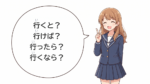


Four Japanese endings all come out as if in English: と, ば, たら and なら. English gets by with one word, which covers the sentence that is always true, the plan you have already made, and the advice you give someone who has just told you their plan. Japanese splits that work four ways, and they look interchangeable until one of them comes out wrong.
Every example sentence has audio, and its English is blurred on purpose. Read the Japanese first, then tap the blur to check yourself.
Here they are on one verb, 行く:
行くと ・ 行けば ・ 行ったら ・ 行くならevery one of them is some version of “if you go”
Why These Four Get Confused
Textbooks teach them as four separate grammar points, months apart, so they arrive as four different ways to say the same thing and you end up choosing by feel. Two questions sort them out:
- Does the result follow automatically, every single time? That is と, and only と.
- Where did the condition come from? If you are supposing it, use ば. If it is one occasion you expect to arrive, use たら. If the other person just handed it to you, use なら.
Look at the second half of your sentence before you choose. If it ends in a request, an order or an invitation, と is out. Always. That one check settles most real sentences on its own.
The Four at a Glance
| Ending | The one-line version | Where the condition comes from | Can a request follow? |
|---|---|---|---|
| ~と | Whenever A, B. Automatic. | A fact about how the world works | Never |
| ~ば | If A holds, then B. | You are supposing it | Only after a state, not an action |
| ~たら | When A happens, B. | One occasion you expect | Yes, freely |
| ~なら | If that is the case, B. | The other person just said it | Yes, freely |

とIt Happens Every Time
Plain present tense plus と, never a past tense in front of it. Use it for nature, machines, road directions and habits: anything you could put in a manual.
春になると、桜が咲きます。
[The blossoms are not deciding anything. Spring arrives and they open, every year, which is the automatic link と marks.]
Nothing after と may express anyone’s will. No commands, no requests, no invitations. If your sentence ends in ~てください, ~ましょう or ~たい, と is the wrong word.
ばSupposing That Were True
Change the verb’s final -u to -eba: 行く → 行けば (if you go), 食べる → 食べれば (if you eat), する → すれば (if you do). Adjectives take ~ければ: 安い → 安ければ (if it is cheap). The weight sits on the condition itself, on what it would take.
毎日練習すれば、上手になります。
[This names what it would take to get good, which is the job ば does best.]
You normally cannot put a request after ば when the ば clause is an action the same person performs. The restriction lifts when it describes a state, which is why 分からなければ、聞いてください is perfectly natural.
たらWhen That Moment Comes
Take the plain past and add ら: 行った → 行ったら (when you go). If you can make the past tense you can make たら, and it accepts almost anything after it, so it is the one to reach for when you are not sure.
駅に着いたら、電話してください。
[One arrival, then a request. と and ば both refuse a request after an action like this, so たら is what is left.]
The one thing たら cannot do is put the second half earlier in time than the first. Whatever follows たら happens after it, always.
ならIf That Is What You Are Telling Me
Plain form plus なら, with nouns and な-adjectives attaching directly: 寿司なら (as for sushi). なら does not schedule an event. It picks up a premise, usually one the other person just supplied, and responds to it.
日本に行くなら、京都がおすすめです。
[Since this is someone giving advice about a trip the listener has just raised, なら is natural.]
なら is also the only one of the four where the second half can happen before the first, which is why 日本に行くなら、パスポートを取らなければなりません means you sort the passport out at home, weeks ahead.
Three Sentences Worth Getting Wrong Once
春になると、お花見をしましょう。
春になったら、お花見をしましょう。
An invitation can never follow と.
東京に着けば、電話してください。
東京に着いたら、電話してください。
Arriving is an action the listener performs, so a request cannot follow ば.
日本に行ったら、パスポートを取ってください。
日本に行くなら、パスポートを取ってください。
The first version is grammatical, which is what makes it dangerous. It tells someone to apply for a passport after they land.
Quick Self-Check
Which ending fits best? Answers below.
1. 日本に___、パスポートを取らなければなりません。行くと ・ 行けば ・ 行ったら ・ 行くなら
2. 春に___、みんなでお花見をしましょう。なると ・ なれば ・ なったら ・ なるなら
3. このボタンを___、切符が出ます。押すと ・ 押せば ・ 押したら ・ 押すなら
4. 東京に___、電話してください。着くと ・ 着けば ・ 着いたら ・ 着くなら
Answers. 1. 行くなら, because the passport comes before the trip and なら is the only one that lets the second half happen first. 2. なったら, because the sentence ends in an invitation and と refuses one. 3. 押すと, because a machine does the same thing every time. 4. 着いたら, because a request cannot follow と or ば after an action like arriving.
If you remember one thing, make it this: look at the end of your sentence first. A request, an order or an invitation there rules out と immediately and usually points you straight at たら.

Samurai and Shogun Makoto+ members get the full deep dive on these four:
- Every rule with three or four examples instead of one
- Audio on all 23 example sentences
- An interactive quiz that tells you why each answer is right or wrong, including the tempting ones
- A printable two-page reference and practice sheet to download
- A new grammar deep dive every week
Not yet a member? Let’s fix that
Already a Samurai or Shogun member? Click here for the in-depth lesson and the download.