
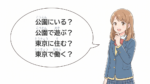


You were taught that に marks location. Then you met 学校で勉強する and the rule broke. It was never quite the rule. に and で both point at places, but they point at different kinds of place, and once you can hear the difference you will stop guessing.
Every example sentence has audio, and its English is blurred on purpose. Read the Japanese first, then tap the blur to check yourself.
Here is the whole lesson in two sentences:
公園に いる ・ 公園で 遊ぶsame park, different particle — one says you are there, the other says you are doing something there
Why に and で Get Confused
Because English uses one word for both. In the park covers standing in it and playing in it, and English never asks you to choose. Japanese asks every time.
The textbook version — “に is location, で is where an action happens” — is close enough to pass a test and not close enough to use. It leaves you with no answer for 東京に住んでいます, where living somewhere is surely something you do, and yet the particle is に.
Before you choose, ask: is this the place where something IS, or the place where something HAPPENS? A place where something simply exists takes に. A place that contains an action takes で. That question settles the large majority of real sentences, including the ones the textbook rule gets wrong.
に and で at a Glance
| Particle | What it marks | Example |
|---|---|---|
| に | Where something exists | 公園に犬がいます。 |
| に | Where you end up | 駅に着きました。 |
| に | A time on the clock | 七時に起きます。 |
| に | The person who receives it | 母に電話しました。 |
| で | Where an action happens | 公園で遊びます。 |
| で | The means or the tool | バスで行きます。 |
| で | The material | 紙で作りました。 |
| で | The cause | 病気で休みました。 |

The whole lesson on one card.
にWhere Something Is
With います and あります — the verbs of existence — the place always takes に, because nothing is happening there. Something is simply present.
公園に犬がいます。
[The dog is not doing anything. It exists, and the park is the point where it exists.]
私は東京に住んでいます。
[The one that breaks the textbook rule. Japanese treats living somewhere as being somewhere, not as an activity — so 住む takes に, always.]
でWhere Something Happens
Put an action in the place and the particle turns into で. The place stops being a point and becomes the space the action fills.
学校で日本語を勉強します。
[The sentence that breaks most learners. School is a place, but studying is what you do there, so で.]
私は東京で働いています。
[Set this beside 東京に住んでいます above. Same city, same speaker, different particle — because living is being and working is doing.]
The Pair That Flips
Hold the place still and change only the particle. Nothing else in these two sentences moves.
弟は部屋にいます。
[Someone asked where he is. The answer is a location, and nothing more.]
弟は部屋で勉強しています。
[Someone asked what he is doing. The room is now the container for an activity, so で.]
でThe Tool, the Material, the Cause
で has three other jobs, and they are all the same idea. If に is a point, で is the medium something passes through — the bus you travel by, the paper it is made from, the illness that kept you home.
はしでごはんを食べます。
[English switches to “with” here, which is why this one gets mistranslated. Japanese sees no change: still the means, still で.]
Three Sentences Worth Getting Wrong Once
1. Working somewhere
The most common mistake in the whole topic, and it comes from learning 住んでいます first. ✗ 日本に働いています。 Living takes に, so working must too — except that working is an action.
日本で働いています。 Keep the pair together in your head: 住む is に, 働く is で.
2. Going by bus
✗ バスに行きます。 This is a real sentence and it does not mean what you want. に marks the destination, so you have just said you are going to the bus.
バスで行きます。 The bus is the means, and the means is always で. If you genuinely mean you are heading over to the bus, バスに行きます is right — which is why the mistake slips past unnoticed.
3. There are books in the library
✗ 図書館で本がたくさんあります。 で feels right because a library is somewhere you go and do things. But look at the verb: あります.
図書館に本がたくさんあります。 The verb decides, not the noun. あります and います are existence, and existence always takes に, however busy the place is.
Quick Self-Check
Pick the particle. Answers below.
- 弟は部屋__宿題をしています。
- かばんの中__財布があります。
- 私は大阪__住んでいます。
- 風邪__会社を休みました。
Answers. 1. で, because 宿題をしています is an action and the room is the space it happens in. 2. に, because あります is existence and existence always takes に. 3. に, because 住む describes being somewhere rather than doing something there — the trap in the whole lesson. 4. で, because a cold is the cause, which is one of で’s quieter jobs.
If you remember one thing, make it this: look at the verb, not the place. If the verb says something exists — います, あります, 住んでいます — the place takes に. If the verb says something is being done, the place takes で. The same park, the same city, the same room will take either particle depending on what you say about it, and that is the whole of it.

Samurai and Shogun Makoto+ members get the full deep dive on に and で:
- Every use with three or four examples instead of one
- Audio on all 27 example sentences
- An interactive quiz that tells you why each answer is right or wrong, including the tempting ones
- A printable two-page reference and practice sheet to download
- A new grammar deep dive every week
Not yet a member? Let’s fix that
Already a Samurai or Shogun member? Click here for the in-depth lesson and the download.