



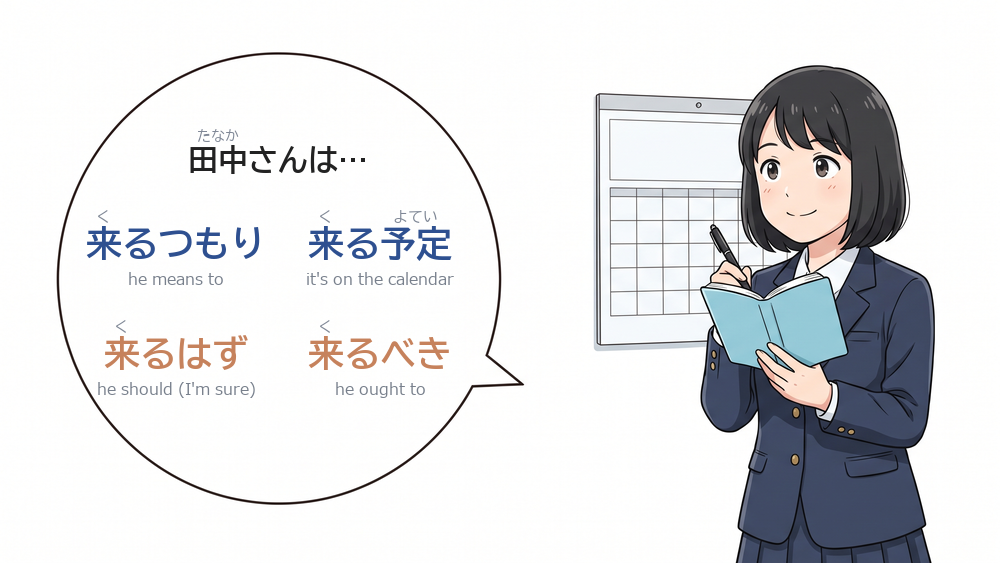
English gets by with two phrases for all of this. “I’m going to” covers what you mean to do and what is on the calendar, and “should” covers what you expect to be true and what you think is right. Japanese splits each of those in two, and a learner who does not know that reaches for the four words interchangeably. A native speaker never would, because each one says something different about where the sentence comes from.
Every example sentence has audio, and its English is blurred on purpose. Read the Japanese first, then tap the blur to check yourself.
Here is the whole lesson in one sentence with four endings. Somebody asks whether Mr. Tanaka is coming to the party:
田中さんは来るつもりです ・ 来る予定です ・ 来るはずです ・ 来るべきですHe means to come. He is scheduled to come. He should be coming, I have every reason to think so. He ought to come. Same man, same party, four different claims: his intention, the calendar, your evidence, your judgment.
Why These Four Get Confused
Because English does not make you choose. “I’m going to Kyoto next week” is true whether you have only just decided or the train tickets are in your pocket. “He should be here” works whether you mean “he left an hour ago, so he must have arrived” or “he promised, and it would be rude not to come.”
Japanese makes the speaker say it. つもり is the plan in somebody’s head, 予定 (schedule, plan) is the plan on the calendar. はず is what the evidence says must be true, べき is what is right. The mistakes that matter are almost all within a pair.
The one questionBefore you choose, ask: where does this sentence come from? A decision in somebody’s head is つもり. The calendar is 予定. The evidence is はず. What is right is べき.
The Four at a Glance
| Form | Comes from | What it claims | Closest English | Example |
|---|---|---|---|---|
| つもり | Someone’s head | A decision somebody has made | I intend to, I mean to | 行くつもりです。I intend to go. |
| 予定 | The calendar | An arrangement, a date, a booking | I’m scheduled to, the plan is | 行く予定です。I’m scheduled to go. |
| はず | The evidence | What must be true, given what you know | should, must, is supposed to | もう着いたはずです。He should have arrived by now. |
| べき | What is right | What ought to happen | should, ought to | 謝るべきです。You should apologize. |
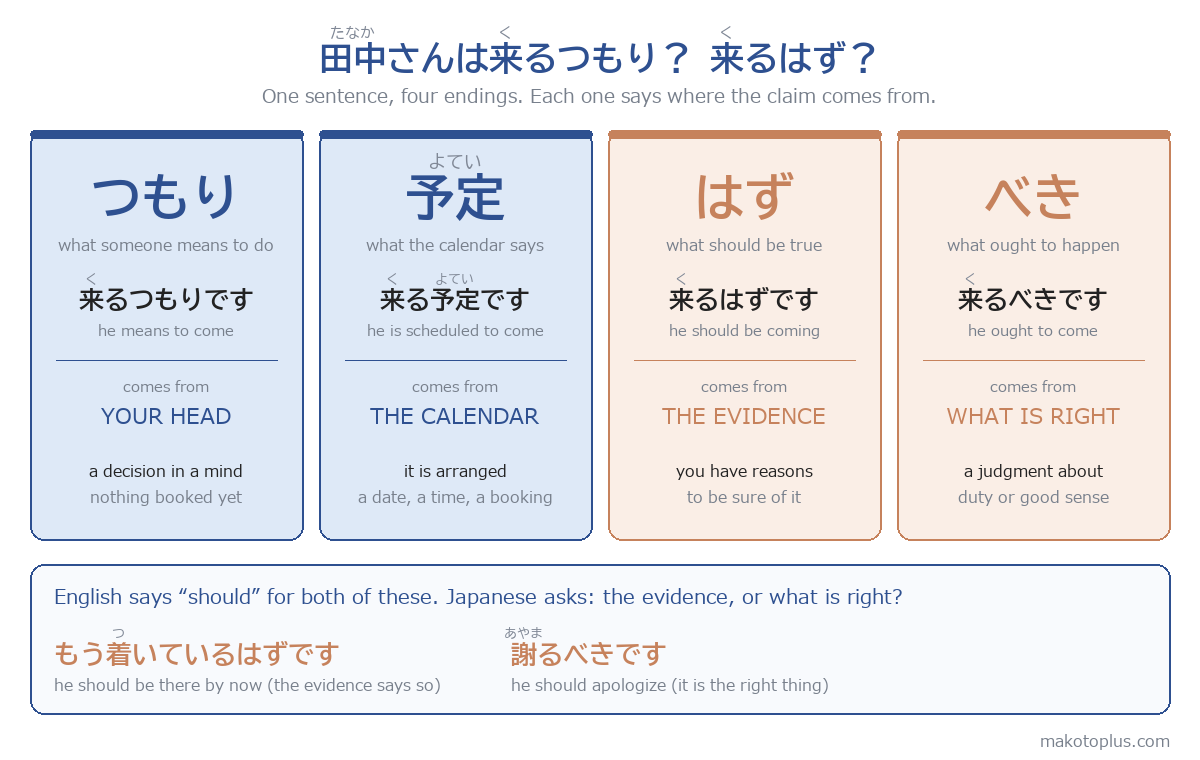
The whole lesson on one card.
つもりYour Head
つもり is a decision in a mind. It comes after the dictionary form of a verb or the ない form. Nothing has to be booked, which makes it the natural word for your own plans and resolutions.
夏休みに日本へ行くつもりです。
[You have decided. Whether you have bought a ticket is another matter, and つもり does not say. Once the flight is booked, 予定 becomes just as natural.]
手伝うつもりだったのに、寝てしまいました。
[つもりだった almost always means the plan did not happen. So do 予定だった (was scheduled to) and はずだった (was supposed to): put any of them in the past and the listener hears the “but” before you say it.]
予定The Calendar
予定 reports an arrangement: a date, a time, a booking. That makes it sound firm and impersonal, which is what you want for trains, meetings and anything other people are counting on. On its own it is also the everyday word for plans: 予定がありますか (do you have plans?).
会議は三時から始まる予定です。
[A meeting has no intentions, so つもり is out. Nobody is working anything out either, so はず is not needed. It is simply on the calendar.]
はずThe Evidence
はず is not a plan at all. It is a conclusion: given what I know, this must be so. Because nobody has to want anything, it works for weather, shops, trains and people alike.
田中さんはもう家に着いているはずです。
[He left an hour ago and it is a twenty-minute walk. You are reasoning, and the English “should” here means “I expect”, not “he ought to.”]
彼が嘘をつくはずがありません。
[はずがない is the strong negative: the evidence rules it out completely. The mild one puts the ない in front: 降らないはず (it shouldn’t rain).]
べきWhat Is Right
べき is a judgment about what ought to happen, and it is strong. It is at home in general rules and opinions; for friendly advice most people reach for ほうがいい (it would be better to) instead.
悪いことをしたら、謝るべきです。
[Nobody is predicting whether you will apologize. The sentence says it is right to. That is the difference between this “should” and はず’s.]
Using Them Together
彼は八時に来る予定だったから、もう着いているはずです。
[The calendar becomes the evidence. 予定 supplies the fact, はず draws the conclusion. This is the most common pairing of all four.]
Three Sentences Worth Getting Wrong Once
1. つもり for something with no mind
✗ 明日は晴れるつもりです。 This says the weather has decided to be sunny tomorrow. English “it’s going to be sunny” hides the problem.
明日は晴れるはずです。 (It should be sunny tomorrow.) The weather has no plans, but you have the forecast, and evidence is はず’s job.
2. はず for advice
✗ もっと野菜を食べるはずです。 Meant as “you should eat more vegetables”, this says “you are expected to eat more vegetables”, as if you were predicting the listener’s diet.
もっと野菜を食べるべきです。 (You should eat more vegetables.) Advice is a judgment about what is right, so it is べき.
3. ない in front of べき
✗ 嘘をつかないべきです。 This copies つもり and はず, where the ない can go in front. べき does not allow it.
嘘をつくべきではありません。 (You shouldn’t lie.) The negative goes after: べきではない.
Quick Self-Check
Pick the ending. Answers below.
- 飛行機は十時に出発する__です。 (はず ・ つもり ・ 予定 ・ べき)The plane is scheduled to leave at ten.
- 三時に出たから、もう着いている__です。 (つもり ・ はず ・ べき ・ 予定)He left at three, so he should be there by now.
- 人の悪口は言う__ではありません。 (予定 ・ はず ・ つもり ・ べき)You shouldn’t speak ill of people.
- 来年こそ、毎日日記を書く__です。 (つもり ・ べき ・ はず ・ 予定)Next year, for sure, I mean to keep a diary every day.
Answers. 1. 予定, because a departure time is the calendar speaking and a plane has no intentions. 2. はず, because から gives the evidence and はず draws the conclusion. 3. べき, a rule about what is right, with its negative after it as べきではない. 4. つもり, because a resolution is a decision in your own head, and nobody books a diary.
If you remember one thing, make it this: つもり comes from someone’s head, 予定 from the calendar, はず from the evidence, and べき from what is right. English says “going to” for the first two and “should” for the last two, so before you pick, ask the one question English never makes you ask: where does this sentence come from?

There is a longer version of this lessonSamurai and Shogun Makoto+ members get the full deep dive on つもり, 予定, はず and べき:
- Every form with four to six examples instead of one, plus where the ない goes in each negative and what the past tense does to a plan
- Audio on all 30 example sentences
- An interactive quiz that tells you why each answer is right or wrong, including the tempting ones
- A printable two-page reference and practice sheet to download
- A new grammar deep dive every week
Not yet a member? Let’s fix that
Already a Samurai or Shogun member? Click here for the in-depth lesson and the download.