




Using the ず ender
In Japanese, there are several ways to mean "to not do something." The ず ender indicates the actor is "not doing" the verb. It is often followed by に to indicate something is not done while doing something else.
For example:
お父さんは何も言わず出かけました。
father | as for | nothing | without saying | left
My father left without saying anything.
In this case, father did something (left) without doing something else (speaking).
Making the ず form
To make this form, simply take the ない form (plain negative) of a verb, drop the ない, and add ず.
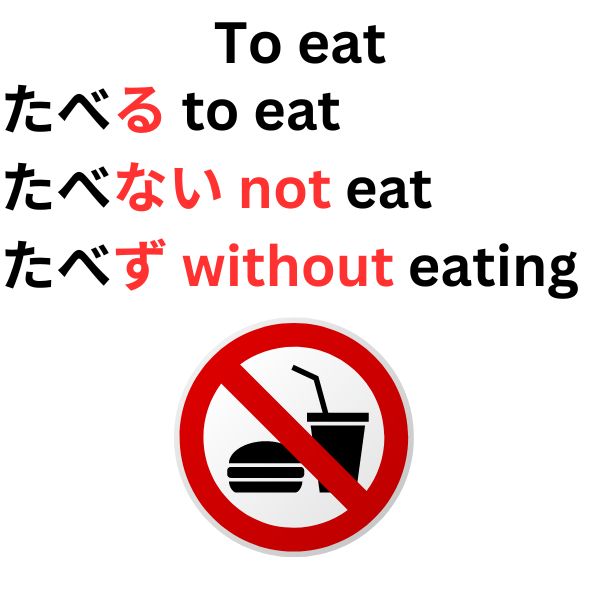
Easy!
Well... yes, for Group 2 verbs.
Verbs in Japanese have three groups.
- Godan Group 1 (-u verb / 五段動詞)
- Ichidan Group 2 (-ru verb / 一段動詞)
- Irregular verbs する (to do) and 来る (to come)
The irregular verbs, you just have to memorize, but there are only two, so this is easy:
- する (to do) → せず (without doing)
- くる (to come) → こず (without coming)
In the case of Godan 五段動詞 Group 1 verbs, it can be a little tricky. This is because the negative and the potential have different roots.
In other words, the plain negative of 言う is 言わない, but the potential negative of 言う is 言えない. Therefore, if you drop the ない and add ず, you’ll have two forms: 言わず (without saying) and 言えず (unable to say).
Confused? Let's look at a verb conjugation chart from Jisho.org:
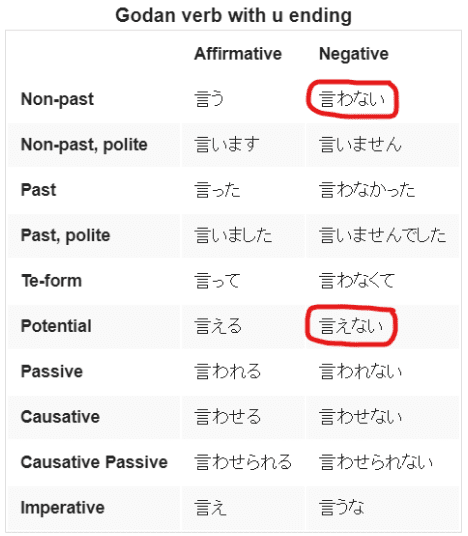
With Group 1 Godan verbs, the negative form is ~わない (don't...) but the potential is ~えない (cannot...).
Let's compare:
言わず
(without saying)
Making "without saying":
- The negative of 言う is 言わない
- Drop the ない
- And you get 言わず which means "without saying."
言えず
(without being able to say)
Making "Without being able to say"
- The potential of 言う is 言える.
- The negative of the potential is 言えない
- Drop the ない
- And you get 言えず which means "without being able to say"
Example Sentences
Let's look at two example sentences to drill this in:
呆気に取られて物も言えずに、その男を見つめた。
He just stared at the man without being able to say anything in astonishment.
Vocabulary
彼は何も言わずに部屋から出た。
He left the room without saying a thing.